

How it works
From “go” to approved,
every step is logged.
Here is what happens when an agent picks up work, whether you asked, a schedule fired, or another agent handed it over.
- 01
Work starts four ways
You ask in chat or by voice. A schedule fires: the daily briefing, the weekly spend review. An event arrives from one of your tools. Or another agent hands work over: a researcher passes what it found to a writer, a writer asks the designer for a visual.
- 02
The brain routes it to one specialist
There is no chain of managers relaying the job. The Head Agent sends it straight to the agent whose role fits, and that agent starts from everything the brain already knows about your business.
- 03
The agent plans, then checks its permissions
Every agent carries a list of tools it may use and tools it may not. The model for each task is picked by cost, capability and how sensitive the data is, and private material can be kept off third-party models entirely.
- 04
A checker looks at it before you do
Reviewers, QA and security sit outside the chain of command. Drafts are fact-checked and tone-checked, changes are tested, and anything wrong goes back with notes instead of landing on your desk.
- 05
Anything risky waits for you
Spending, publishing, sending email, deleting, changing credentials or permissions: each arrives as one request with the proposed action, the expected outcome, the cost and the evidence. You approve, deny or send it back.
- 06
It is logged, and the swarm learns
Every action, hand-off, tool call and model call lands in the audit log with its cost. The hand-offs you approve get used more, your corrections go into each agent’s memory, and the next draft is closer to how you would have done it.
The map
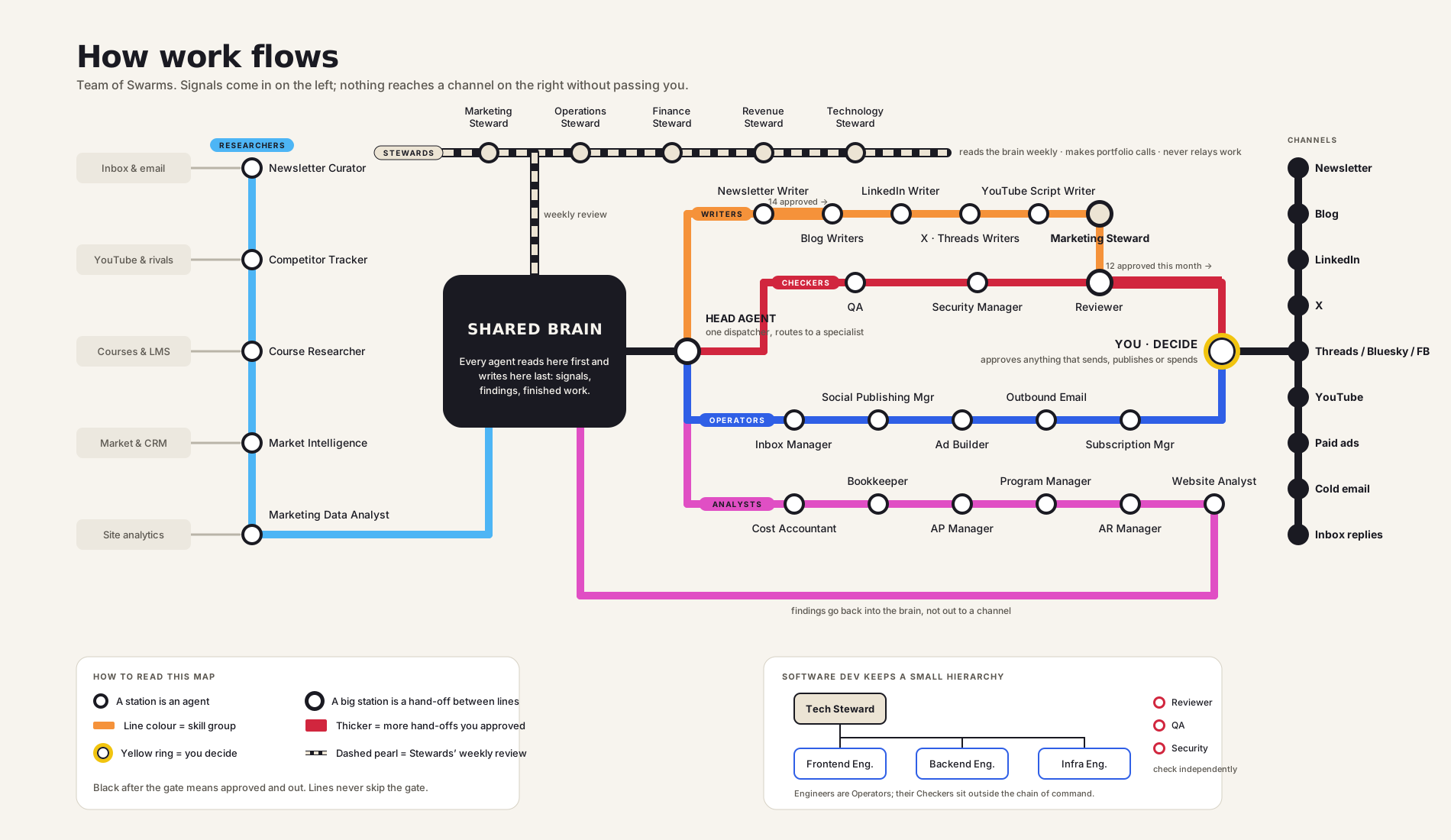
Signals come in on the left. Every line passes through the shared brain, and nothing reaches a channel on the right without passing you.
Agents do this on their own
- Read analytics, social, finance and website data
- Write reports and daily briefings
- Draft posts, scripts, emails and invoices
- Create and update tasks and notes
- Hand work to other agents and ask them for help
Agents wait for you
- Spend money
- Publish anywhere
- Send external email or start a campaign
- Delete anything
- Change credentials, permissions or integrations